5 Living Room Design Ideas That Balance Style & Structure
Sometimes, the key to nailing down a design is looking up. See how five distinctive ceiling beam designs use color, texture, contrast, and complementary elements to create living rooms that feel structured, stylish, and full of life.
 By ABBY winstead
Design Specialist
By ABBY winstead
Design Specialist
Living rooms do a lot of heavy lifting. They’re where we go to relax, gather, entertain, and spend some of our most cherished time at home. This also means an outdated or underdesigned living area can spill over and negatively affect the feel of an entire interior.
The good news is that upgrading a living room doesn’t require replacing everything in it. The best living room design ideas often come from rethinking the architectural details that shape the space in the first place.
Ceiling beams can introduce warmth, create architectural rhythm, emphasize ceiling height, or give a large living area a greater sense of definition. And because beam styles range from lightly weathered to heavily textured—and from convincing faux wood to real cedar—you can use them to refine or reimagine a wide variety of interior styles.
The five living rooms below show just how different that effect can be. One pairs light wood beams with sculptural curves, another builds depth through caramel and chocolate tones, and another uses rugged texture to bring warmth to a bright room. You’ll also see a softer tone-on-tone coastal approach and a real wood beam design that connects the indoors with natural colors and textures.
Together, they offer five very different ways to make the ceiling an intentional part of your ideal living room design.
Create Contrast With Shape, Color, and Texture
Contrast doesn’t always mean dark against light. It can come from pairing a smooth surface with a weathered one, a curved silhouette with a straight architectural line, or a pale room with just enough warm wood to give it definition.
The following three living rooms show how ceiling beams can provide that counterbalance while still feeling at home within the larger design.
1. Layer Warm Woods and Rich Neutrals

A neutral living room doesn’t have to stay within a narrow range of beige and gray. Layering related tones with different depths, undertones, and textures can create a space that still feels calm while gaining more depth and dimension.
This living room is a great example. The cream sofa establishes a light foundation, while chocolate-brown lounge chairs and golden accents bring in richer color. Between those two ends of the palette, Heritage Faux Wood Beams in Caramel help tie everything together.
Their moderately distressed texture introduces the character of aged wood overhead, while the warm finish relates naturally to the room’s midtones. Rather than matching one furnishing exactly, the beams help bridge the lighter and darker elements throughout the space.
That same layering continues through texture. Soft upholstery and drapery contrast with the visible wood grain of the beams and the textured fireplace wall, leaving the eye plenty to explore even though the overall palette remains restrained.
Plus, the repeated beam lines also give the ceiling a stronger presence. They create rhythm overhead and help make the open-ended living area feel grounded and comfortably proportioned.
The broader idea isn’t to recreate this exact cream-and-caramel palette. It’s to use ceiling beams as part of a layered tonal scheme. In a lighter room, that could mean light oak against warm whites. In a moodier space, deeper walnut or brown tones could play the same role. What matters is choosing a beam finish that relates to the room’s palette without disappearing into it—or feeling disconnected from everything below.
Shop Featured Products
2. Add Rustic Texture to a Bright, Clean-Lined Room
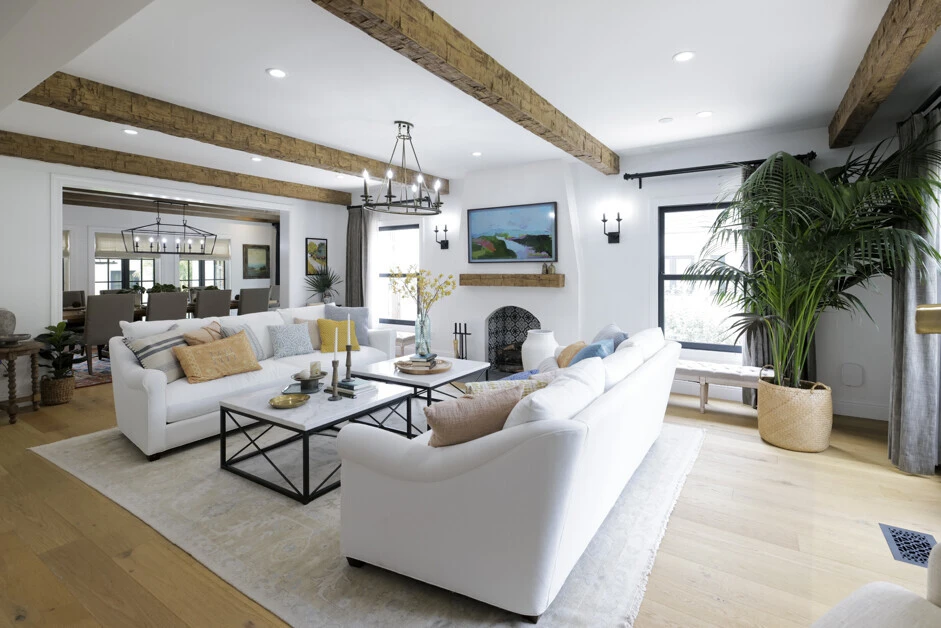
Rustic texture doesn’t require a fully rustic living room. In fact, rougher surfaces can have even more impact when they’re paired with cleaner, simpler surroundings.
This room shows that contrast clearly. Crisp white upholstery, pale walls, streamlined black metal tables, and abundant natural light create a bright, polished foundation. Overhead, Rough Hewn Faux Wood Beams in Caramel introduce a very different surface quality.
These beams are heavily distressed, with pronounced ridges, grooves, and grain details that recreate the character of rough-hewn lumber. Against the smoother furnishings and finishes below, that texture becomes a focal point without forcing the rest of the room into a rustic theme.
The Caramel finish also adds warmth to the room’s mostly light palette, connecting naturally with the pale flooring and smaller tan and golden accents. Because the beams continue toward the adjoining dining area, they also help create visual continuity across the open layout.
Beyond this singular example, the main takeaway is to use textural contrast strategically. If your living room feels too polished, too smooth, or too one-note, you don’t necessarily need to add more decor. A more worn beam texture can bring age, warmth, and character overhead while allowing the rest of your space to stay clean and restrained.
Shop Featured Products
3. Balance Soft Curves With Strong Architectural Lines
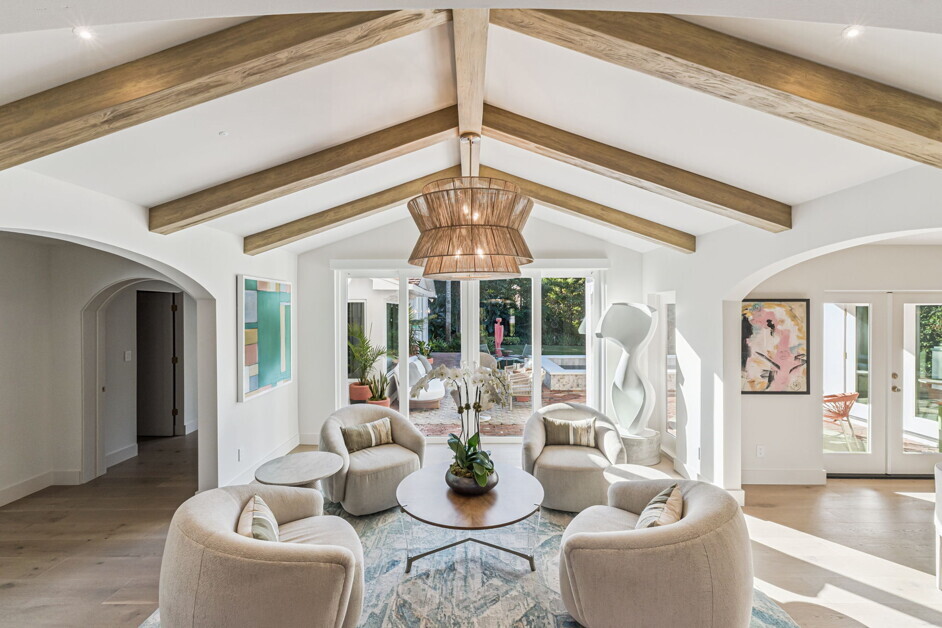
Curved furniture can make a living room feel inviting and relaxed, but rooms filled with rounded forms often benefit from a few stronger lines to keep the design feeling structured.
That balance is on full display in this 2026 TNAR living room. Rounded lounge chairs gather around a circular coffee table, arched openings soften the architecture, and a sculptural floor piece adds another fluid shape. Overhead, Driftwood Faux Wood Beams in Blonde Oak introduce a connective contrast.
The beams follow the pitch of the vaulted ceiling in long, repeated lines that draw the eye upward and emphasize the room’s height. Their placement gives all those softer shapes something to play against. This leads to a stronger sense of balance throughout the space.
Meanwhile, the Blonde Oak finish keeps the effect light and easygoing. It adds warmth against the white ceiling while relating naturally to the flooring, woven pendant, and outdoor setting. Plus, the Driftwood style’s lightly distressed texture adds visible wood character without making the room feel rugged.
Zooming out, the key takeaway is to embrace the art of counterbalancing shapes. If your living room leans heavily into curves—through sofas, barrel chairs, round tables, arched openings, or sculptural decor—beamwork can introduce straight, architectural lines that keep the room from feeling too soft or visually loose.
Shop Featured Products
See Driftwood In Your Space Before You Commit
Order one of our new Driftwood Beam Sample Kits to see how different Driftwood finishes look in your space. Even better? Your sample order total is deducted from a full order placed within six months.
Let Beamwork Blend Into the Bigger Picture
Not every ceiling needs dramatic contrast. In a softer palette, beams can sit closer in color to their surroundings and still create plenty of architectural interest through shape, shadow, and texture.
These next two living rooms show how a more integrated approach can work wonders.
4. Mix Real Wood Character With Crisp Finishes
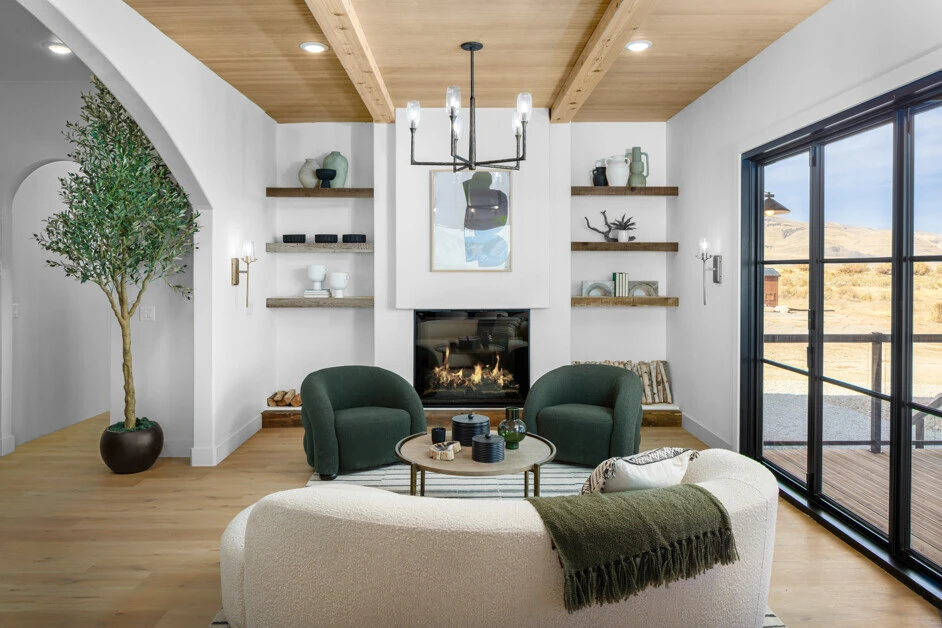
Natural wood can add warmth and variation to a polished living room without diluting its overall elegance.
In this space, Custom Finished Wire Brushed Real Wood Beams bring the grain, color variation, and tactile character of real cedar into a room defined by smooth white walls, dark window frames, streamlined lighting, and clean fireplace architecture.
The contrast between natural and refined surfaces is what gives the room depth. The wire-brushing process raises the wood fibers to accentuate the cedar’s grain, creating visible texture without the rugged look of a heavily distressed beam.
The custom finish also sits close in tone to the surrounding wood ceiling treatment, so the overhead elements feel cohesive rather than pieced together. Below, deep green seating, an olive throw, pale wood flooring, and a large indoor tree continue the nature-inspired palette, while the curved sofa and arched opening soften the room’s straighter architectural lines.
The broader design principle is to use real wood as a grounding material within a cleaner scheme. You don’t need an entirely wood-heavy room to benefit from its warmth. A few substantial architectural elements overhead can introduce natural character while the rest of the space remains crisp and contemporary, transitional, organic modern, or somewhere in between.
Structural Note: Barron’s Wire Brushed Wood Beams are made from real cedar, but they are hollow decorative box beams rather than solid or load-bearing timbers. That construction delivers authentic wood character in a lighter, easier-to-install format than comparable solid beams.
Shop Featured Products
5. Create Soft Contrast With Tone-on-Tone Beams
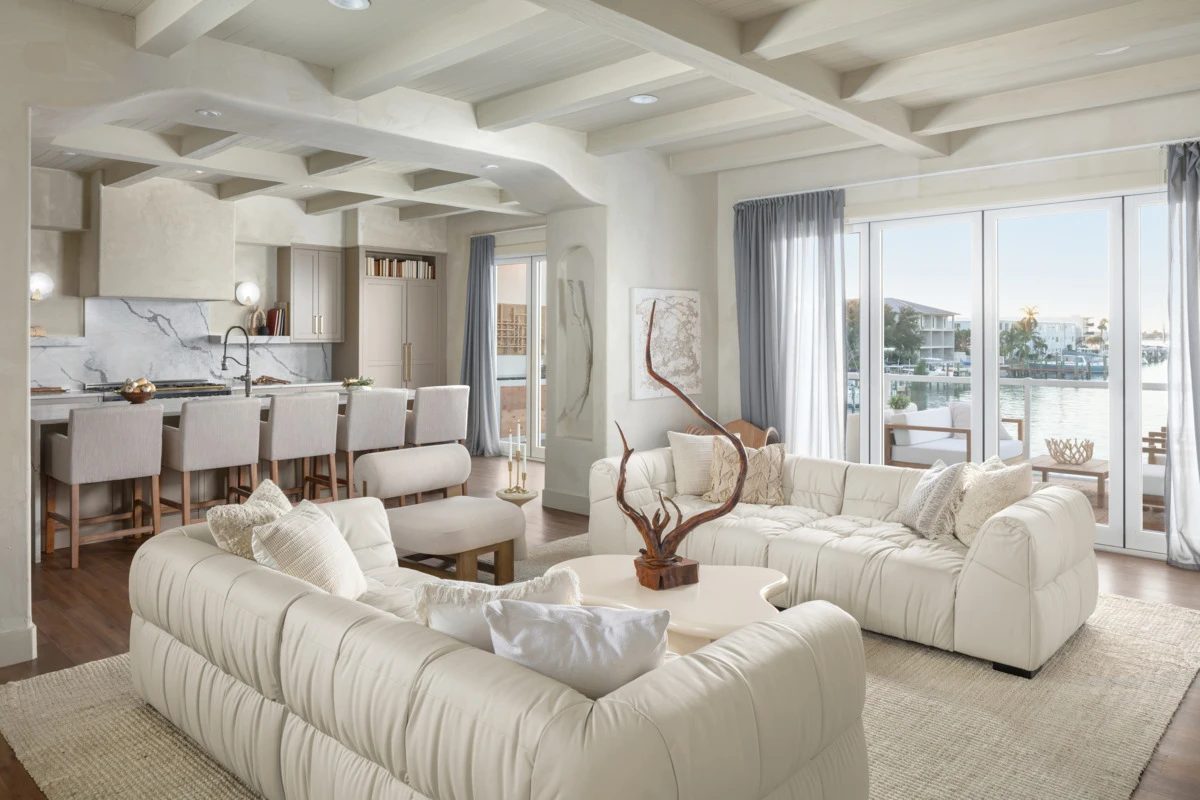
This waterfront living room proves that ceiling beams don’t need to be dark to make an impact.
Here, Custom Finished Driftwood Faux Wood Beams stay within the same creamy tonal family as the surrounding architecture. Instead of creating sharp contrast, the beams stand out through their lightly distressed texture, dimensional form, and repeated placement.
That creates a quieter kind of depth. The beam layout gives the ceiling a strong architectural pattern, while the pale custom finish keeps the effect from feeling heavy. Below, off-white sculptural sofas, a natural-textured rug, soft gray drapery, and warm flooring continue the subtle layering.
The waterfront setting also reinforces the room’s relaxed, airy character. Rather than relying on obvious nautical motifs, the space hints at modern coastal design through light, texture, a restrained palette, and a strong visual connection to the outdoors.
The general takeaway is that beam contrast doesn’t always need to come from color. If you prefer a softer look, choose a beam finish that sits relatively close to the ceiling and let dimension, texture, and shadow do the work. The same principle can apply to warm whites, pale woods, muted taupes, or deeper tonal palettes.
Shop Featured Products
Plan Your Living Room Ceiling Beam Design
Finding a room you love is the easy part. Translating that inspiration to your own ceiling takes a little more planning.
Start by thinking about what you want the beams to accomplish visually. Do you want to emphasize the pitch of a vaulted ceiling? Give a wide room more rhythm? Draw the eye toward a fireplace or view? Or create stronger visual continuity between different areas of an open-plan space?
Spacing and direction can change the effect considerably. Widely spaced parallel beams can create a simpler rhythm, while a denser layout makes the ceiling a more prominent feature. Grid-style arrangements introduce another layer of geometry altogether.
Barron Designs’ Ceiling Beam Design Guide: Spacing, Direction & Preview Tool can help you think through beam placement and preview different approaches before settling on a design.
Finish matters, too. As these five rooms show, beams can either contrast with the ceiling or blend more closely into it. Neither approach is inherently better. The right choice depends on your palette, your architecture, and how much visual emphasis you want to place overhead.
DIY Living Room Beam Installation Resources
Adding ceiling beams may look like the kind of living room project that needs to be left entirely to professionals. Fortunately, decorative box-beam construction can make the upgrade much more approachable for DIYers.
Barron Designs’ faux wood beams are made from lightweight high-density polyurethane, making them easier to handle than heavy natural timbers. Barron’s real wood beams are also hollow box beams rather than solid timbers, significantly reducing their weight while preserving the character of real wood.
A successful installation starts with clear guidance. Visit our Beams Installation Resource Hub for instructions covering different beam applications and project needs. For ceiling designs like many of the living rooms featured above, Barron also provides detailed Installation Instructions for Flush Mounted Box Beams that walk through the process step by step.
Still working through project details? Our Beams FAQ covers additional topics including product dimensions, ordering, shipping, and other planning considerations.
Breathe New Life Into Your Living Room
Though these five featured spaces take very different approaches to living room design, they share one crucial commonality: the ceiling isn’t treated as an afterthought.
Your living room may call for a different combination of texture and finish—and seeing those choices in your own space can make the decision much easier. Before committing to full-size beams, we recommend ordering Beam Samples to compare colors and textures under your actual lighting and alongside the flooring, furniture, and finishes already in your living room.
Whether you’re striving for refinement or reinvention, we can’t wait for you to discover the beam texture and finish that makes your living room feel more alive.